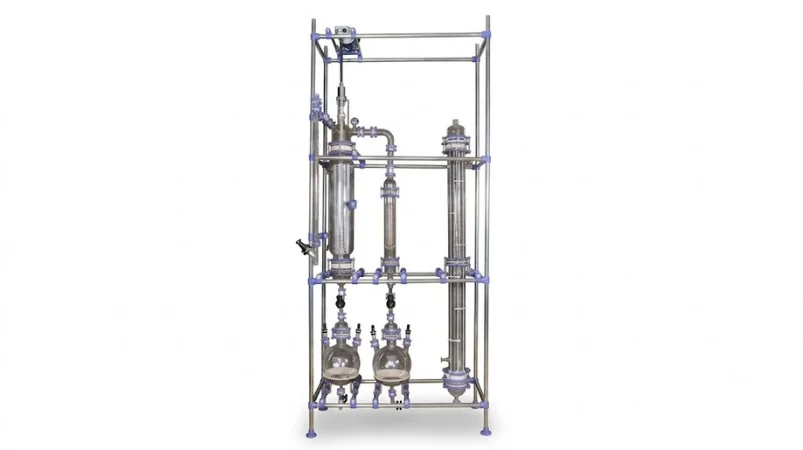
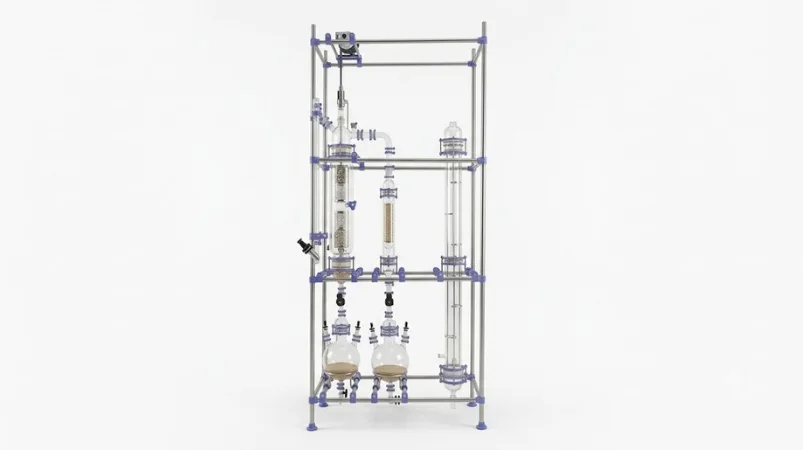
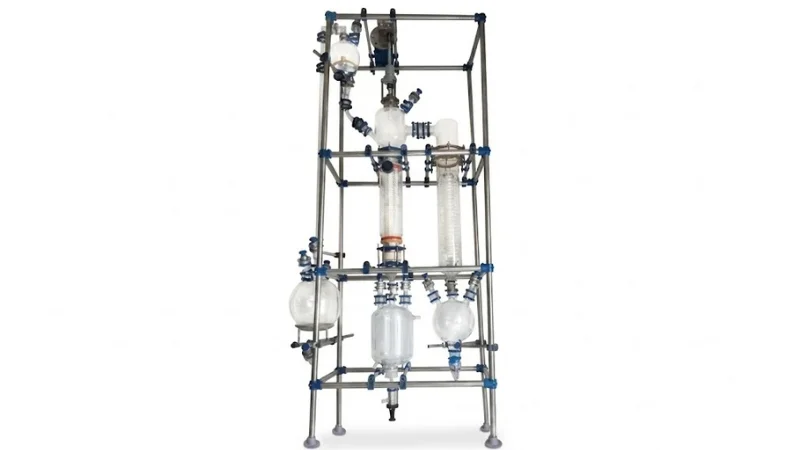
Wiping Film Evaporators are advanced thin-film evaporation units designed for the efficient removal of solvents from heat-sensitive, viscous, or foaming liquids. With rotating wiper blades, they create a thin uniform film, enabling rapid evaporation and precise thermal control. Ideal for pharmaceutical, chemical, food, and specialty industries.
Overview
Working Principle
Key Advantage: Short residence time preserves delicate compounds while maximizing throughput.
Salient Features & Benefits
Technical Specifications
|
Parameter |
Specification |
|
Design |
Cylindrical glass body with rotating wiper blades |
|
Heating |
Jacket or shell heating with thermal fluid |
|
Wipers & Seals |
PTFE or corrosion-resistant materials |
|
Operating Temperature |
Product: up to 200°C; Jacket: up to 230°C |
|
Vacuum Compatibility |
5 mm Hg to 0.005 mm Hg |
|
Capacity |
Lab to pilot-scale modular units |
|
Material |
Borosilicate glass, PTFE, SS316 (optional) |
|
Vapor Path |
Short path to condenser |
|
Surface Area |
DN-80 x 0.15 m² to DN-150 x 0.5 m² |
|
Pressure |
Jacket pressure: up to 2.0 bar (g) |
|
Installation |
Vertical, skid-mounted or modular frame |
Construction Details
Applications
Optional Accessories & Modules
Advantages Over Conventional Evaporation
Maintenance & Operation Tips
Frequently Asked Questions (FAQ) – Wiping Film Evaporator
Q1: What is a Wiping Film Evaporator?
It is a thin-film evaporation system where a rotating wiper spreads liquid into a thin film on a heated glass surface, enabling fast and gentle evaporation of heat-sensitive or viscous materials.
Q2: What industries use Wiping Film Evaporators?
Pharmaceutical, chemical, fine chemicals, food & beverage, cosmetics, and R&D labs use it for solvent recovery, distillation, and concentration of sensitive materials.
Q3: Can it handle viscous or foaming liquids?
Yes! The rotating wiper system ensures uniform thin-film formation, which allows processing of high-viscosity, foaming, and heat-sensitive liquids without degradation.
Q4: What is the maximum operating temperature?
Product-side temperatures up to 200°C and jacket-side temperatures up to 230°C, depending on the system configuration.
Q5: Can the unit operate under vacuum?
Yes, it can operate at vacuum levels ranging from 5 mm Hg to 0.005 mm Hg, improving evaporation efficiency and protecting heat-sensitive products.
Q6: What materials are used in construction?
All wetted parts are made of high-precision borosilicate glass and PTFE, with optional corrosion-resistant stainless steel for certain components.
Q7: How do I clean and maintain the evaporator?
Regular cleaning of the glass body and wipers is recommended. Inspect PTFE seals and wiper blades for wear and replace as needed. Ensure vacuum and heating systems are checked before operation.
Q8: Can it be scaled from lab to pilot plant?
Yes, modular designs allow for lab-scale, pilot-scale, and industrial applications, making it flexible for various production needs.
Q9: What accessories can be integrated?
Optional accessories include vacuum pumps, condensers, feed pumps, digital controllers, and safety valves for optimized operation.
Q10: Why choose a Wiping Film Evaporator over conventional evaporation?
It offers higher evaporation rates, short residence time, minimal product degradation, and reduced fouling, making it ideal for sensitive and viscous materials.