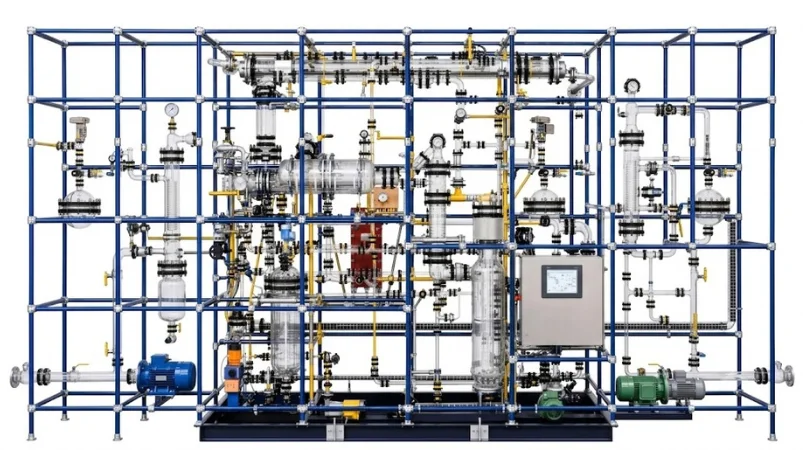
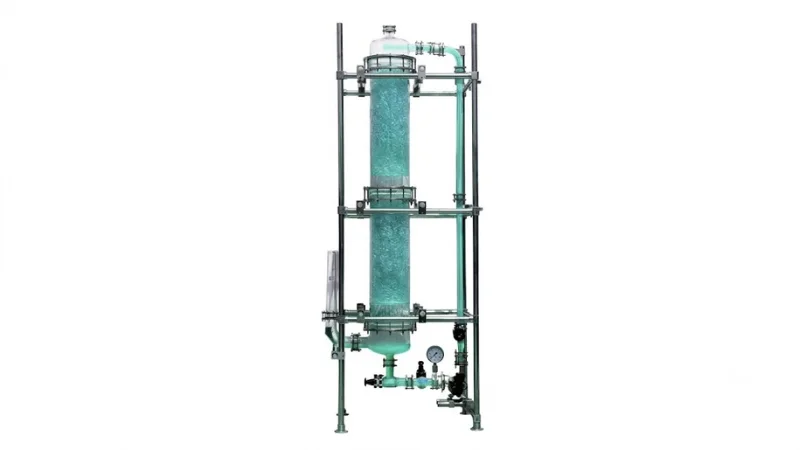
HCL Gas Absorber

  • Home
  • HCL Gas Absorber

HCL Gas Absorber

Efficient Absorption & Recovery of Hydrogen Chloride Gas

The HCL Gas Absorber is a specialized gas–liquid mass transfer system designed to safely absorb hydrogen chloride (HCl) gas into water, converting it into commercial-grade hydrochloric acid (HCl).
These systems are widely used where HCl gas is generated as a by-product and direct venting is strictly prohibited due to environmental and safety regulations.

Under normal operating conditions, 30%–31% hydrochloric acid can be continuously produced with high absorption efficiency.

Why HCL Gas Absorption Is Critical

  • HCl gas cannot be released to atmosphere
  • Highly corrosive and hazardous
  • Strict pollution control compliance required
  • Valuable chemical that can be recovered and reused

The HCL Gas Absorber ensures:

  • Safe containment
  • Environmental protection
  • Economic recovery of acid

Absorption Principle (Adiabatic Absorption)

The most effective method for HCl gas recovery is adiabatic absorption, where:

  • No external heat input is supplied to the absorption zone
  • HCl gas flows counter-currently to fresh water
  • The heat of absorption vaporizes part of the water
  • Vapor rises to the column top along with non-condensable gases
  • Condensed vapors and make-up water are returned to the column

Recommended gas loading:
For effective operation, gas flow should not fall below 50% of design capacity.

Typical outlet acid temperature:
45°C – 50°C

Types of HCL Gas Absorber Systems

1. Adiabatic Packed Column Absorber

This is the most commonly used absorber for HCl gas recovery.

Construction & Operation:

  • Vertical packed glass column
  • Gas introduced from the bottom
  • Fresh water fed from the top
  • Multiple packed sections for high contact efficiency
  • Condenser at the top
  • Acid collected at the bottom

Key Advantages:

  • High absorption efficiency
  • Simple and reliable operation
  • Suitable for continuous duty
  • Produces 30–31% HCl directly

2. Falling Film HCL Absorber

The Falling Film Absorber functions as a heat exchanger–type absorber and is always vertically mounted.

Working Principle:

  • Absorbent liquid flows as a thin film inside tubes
  • Gas and liquid move co-currently downward
  • Each tube acts as an individual absorber
  • Cooling water flows on the shell side
  • Heat of absorption is continuously removed

Key Benefits:

  1. Lower absorption temperature
  2. Higher absorption rate
  3. Better control of heat removal
  4. Ideal for high gas loads

3. Venturi Scrubber (HCL Gas Scrubber)

A Venturi Scrubber is used where intense gas–liquid mixing is required.

Working Principle:

  • Gas accelerates through a venturi throat
  • Liquid is injected at high velocity
  • Turbulent mixing ensures rapid absorption

Salient Features:

  • No moving parts
  • Virtually maintenance-free
  • Handles large gas flow rates
  • Extremely compact design
  • Can be installed directly on tanks
  • Suitable for single or multi-stage operation

Additional Uses:

  • Tail-gas absorber
  • Vacuum generation
  • Dust and fume scrubbing

Objectives of HCL Gas Absorber Systems

  • To absorb and neutralize HCl gas
  • To recover hydrochloric acid
  • To remove harmful gases from exhaust streams
  • To purify gas mixtures
  • To recover valuable chemicals from waste gases
  • To meet pollution control norms

Salient Features

  • Simple and robust design
  • High gas–liquid contact efficiency
  • Corrosion-resistant construction
  • Continuous and stable operation
  • Low operating cost
  • Easy integration with HCL Gas Generators
  • Available as fixed or skid-mounted mobile units

Mobile glass & PTFE scrubbers are also available for laboratory and pilot-scale use, mounted on stainless steel skid structures for easy maneuverability.

Construction Materials

  • Borosilicate Glass 3.3
  • PTFE-lined internals
  • Corrosion-resistant structural supports
  • Leak-tight joints and flanges

Applications

  • HCL gas recovery from chemical reactors
  • Acid gas scrubbing systems
  • Pollution control & emission treatment
  • Pharmaceutical & bulk drug plants
  • Fine and specialty chemical industries
  • Pilot plants and R&D facilities
  • Tail-gas treatment systems

Key Benefits

  • Converts hazardous gas into useful product
  • Ensures regulatory compliance
  • Reduces raw material losses
  • Improves plant safety
  • Environment-friendly operation
  • Long service life due to glass construction

Frequently Asked Questions (FAQs)

Q1. What HCl concentration can be achieved?
Typically 30–31% hydrochloric acid under normal conditions.

Q2. Is external heating required?
No. Adiabatic absorbers operate without external heat input.

Q3. Can this system handle non-condensable gases?
Yes. Non-condensables are separated and managed via condensers and vents.

Q4. Which absorber should I choose?

  • Packed Column: General-purpose absorption
  • Falling Film: High heat load, high efficiency
  • Venturi Scrubber: Compact, high gas flow, fume control

Q5. Can it be supplied as a turnkey system?
Yes. Systems can be supplied standalone or integrated with gas generators and purification units.

Note: HCL Gas Absorbers can be engineered as customized, turnkey solutions based on gas composition, flow rate, acid concentration, and plant layout.


Related Products

HCL Gas Absorber

View Details

HCl Purification System

View Details

HCl Adiabatic Absorption System

View Details

HCl Gas Generator System

View Details