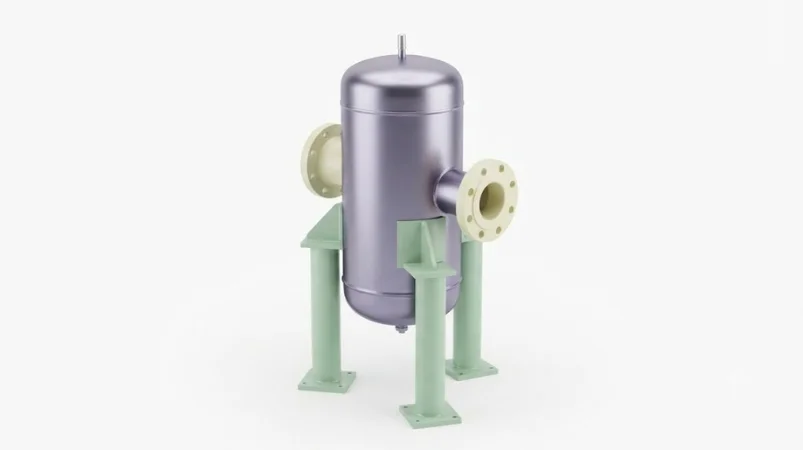
Vessel Support Systems for Vessels in Heating Mantles

  • Home
  • Vessel Support Systems for Vessels in Heating Mantles

Vessel Support Systems for Vessels in Heating Mantles

Vessels installed inside heating mantles require specially designed structural support frames to ensure safe operation under continuous thermal load. The support system must accommodate the combined geometry of the vessel and heating mantle, while maintaining mechanical stability and avoiding stress transfer to the glass body.

Unlike free-standing vessels, mantle-mounted vessels are surrounded by electrical heating elements and insulation, which necessitates additional clearance, controlled alignment, and rigid yet non-restrictive support.

Functional Role of the Support System

The support frame for vessels in heating mantles serves multiple critical functions:

  • Carries the combined weight of vessel + mantle
  • Maintains coaxial alignment of vessel and mantle
  • Provides clearance for insulation and wiring
  • Prevents lateral movement during operation
  • Avoids glass stress due to frame contact

The frame must support without clamping, allowing the glass to expand freely during heating cycles.

Recommended Minimum Frame Sizes

The following table provides typical minimum structural guidelines for designing vessel support frames used with heating mantles. These values are indicative and may be adjusted based on operating conditions, material selection, and safety factors.

Recommended Minimum Frame Sizes for Vessels in Heating Mantles

Vessel Volume (L)

Tube Size NB (mm)

Min. Frame Depth × Width (mm × mm)

20

25

400 × 600

50

25

600 × 800

100

25 / 30

800 × 800

200

30

800 × 1000

Actual frame dimensions should be verified based on mantle type, insulation thickness, and site-specific constraints.

Structural Design Considerations

When designing or selecting support systems for vessels in heating mantles, the following technical aspects are critical:

Clearance Management
Adequate space must be maintained for:

  • Heating elements
  • Thermal insulation
  • Temperature sensors and wiring
  • Safe airflow and heat dissipation

Load Distribution

  • Frame must carry vertical load uniformly
  • No point loading on glass shell
  • Neck and nozzles must remain stress-free

Thermal Expansion Allowance

  • Glass and steel expand at different rates
  • Supports must not restrain axial expansion
  • Sliding or guided supports may be used where required

Materials of Construction

Commonly used materials include:

  • Galvanized Mild Steel (cost-effective, industrial use)
  • Carbon Steel with epoxy or paint coating
  • Stainless Steel (SS 304 / SS 316) for corrosive or clean environments

Contact surfaces near glass are typically isolated using rubber pads or PTFE liners where necessary.

Integration with Other Support Elements

Support frames for heating mantles are usually integrated with:

  • Base frames or floor-mounted supports
  • Column or reactor support structures
  • Lateral bracing to nearby rigid members
  • Instrument mounting brackets

This ensures the entire assembly behaves as a single stable structure.

Typical Use Cases

  • Glass reactors with electrical heating mantles
  • Laboratory and pilot-plant heating setups
  • Batch reaction vessels requiring uniform heating
  • Distillation vessels with bottom heating
  • Systems operating under repeated heating and cooling cycles

Key Advantages

  • Improved glass safety during heating
  • Stable and repeatable vessel positioning
  • Reduced risk of thermal stress and cracking
  • Better access for maintenance and inspection
  • Long-term structural reliability

Related Products

Vessel Support Systems for Vessels in Heating Mantles

View Details

Vessel Support Systems for Vessels in Vessel Holders

View Details

Vessel Support Systems for Vessels in Heating Baths

View Details