Coil Condenser

coil condenser
coil condenser

coil condenser

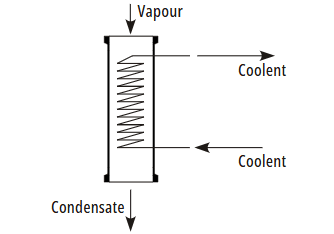
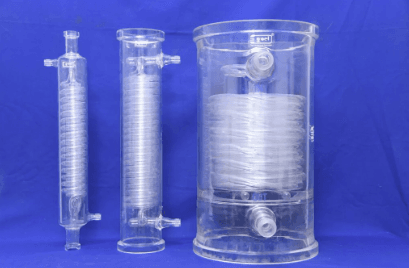
Coil Condensers are used for condensation of vapours and cooling of liquids. Condensers are made by fusing number of parallel coils in a glass shell. Coils are made in different diameters using tubes of different bores.

The average co-efficient of heat transfer in coil condenser is considered as :-
Condensation 200 – 270 Kcal/m2, hr, °C appx.
Cooling 100 – 150 Kcal/m2, hr, °C appx.

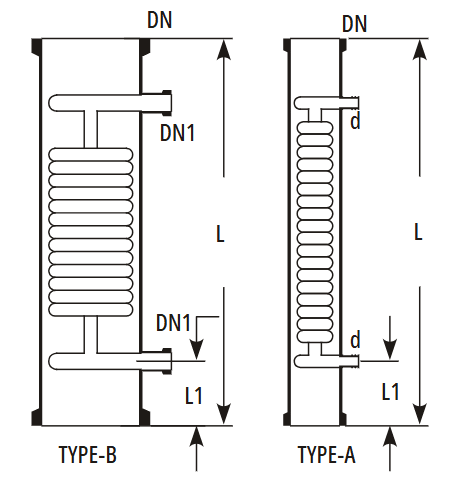
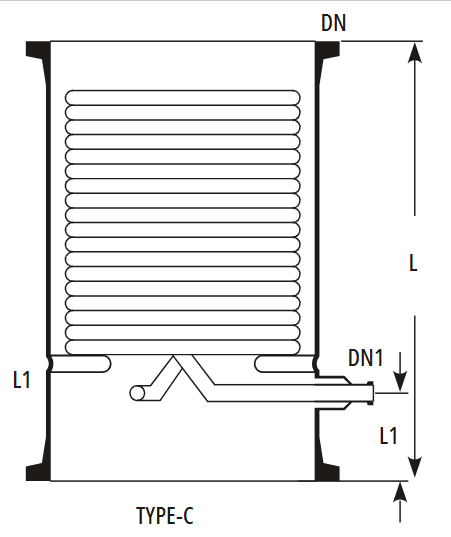
 Cat. Ref. DN d/DN1 L L1 Type Actual
H.T.A.
m2
Cross 
Area 
Cm2
Free
Coolant
Rate
kg/hr.
Max.
Jacket
Cap.
Litre
 HE3/3.5* 80 16 600 75 A 0.35 5 1300 2
 HE4/5* 100 19 600 75 A 0.50 30 2400 4
 HE4/6 100 19 750 100 A 0.60 30 2400 6
 HE6/10 150 25 600 100 B 1.00 52 2600 9
 HE6/15* 150 25 850 100 B 1.50 52 2600 11
 HE9/25* 225 25 800 110 B 2.50 125 3300 18
 HE12/25 300 25 600 125 B 2.50 175 5700 25
 HE12/40* 300 25 900 125 B 4.00 175 5700 35
 HE16/40 400 25 600 125 B 4.00 450 6200 60
 HE16/50 400 25 700 125 B 5.00 450 6200 70
 HE18/60 450 40 750 150 C 6.00 820 4800 100
 HE18/80 450 40 900 150 C 8.00 820 6200 110
 HE24/120 600 50 1250 300 C 12.00 1520 6200 265

Precautions to be taken in use of coil condensers :
– Vapors should be passed through shell only.
– Maximum pressure of coolant should be 2.7 bars.
– Adequate flow of coolant should be used.
– Steam should not be used in coils.
– Coolant should not be heated to boiling point.
– Coolant control valve should be turned slowly.
– Coolant should be allowed to drain freely.
– Brine can be used in coils in a closed circuit.
– Water main should be connected with flexible hose.
– Ensure no freezing of water remaining in the coils.
– Condensers should be mounted vertically only.
– Condensers can be mounted in series to provide larger surface area.

METHODS OF USE:
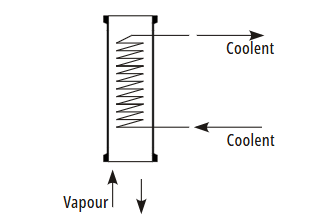
Vapours from bottom

Vapours from bottom

This method is simple to install over a reactor. However this results in condensate returning substantially at its condensing temperature. In this method care must be taken that condensate is not excessive that it can lead to “logging” the coils and create back pressure in the system. Generally a reflux divider is used below the condenser to take out the distillate.

Vapours from bottom

Vapours from top

This method produce a cool condensate using the entire cooling surface area. This method should be used where the condensate can lead to “logging” of coils.

Heat Exchangers Coil Type Glass Condenser – High-Performance Condensation & Cooling Solution

🔬 Product Overview of coil condenser:

The Heat Exchangers Coil Type Glass Condenser is an advanced heat exchange solution designed for efficient vapor condensation and liquid cooling in chemical, pharmaceutical, and industrial applications. Manufactured using high-quality borosilicate glass, our condensers ensure maximum heat transfer efficiency, chemical resistance, and durability. With coiled glass tubes fused within a protective shell, this condenser is ideal for handling aggressive chemicals and high-temperature processes while ensuring superior performance in laboratories and industrial setups.

⚙ How Does It Work? (Step-by-Step Process)

  1. Vapors Enter the Condenser: Hot vapors pass through the glass shell, initiating the heat exchange process.
  2. Coiled Tubes Facilitate Heat Transfer: The internal glass coil tubes provide a large surface area, enabling efficient heat dissipation.
  3. Coolant Circulates Through Coils: A cooling fluid (water/brine/other coolants) circulates within the coils, absorbing heat.
  4. Condensation Occurs: As heat is transferred, the vapors condense into liquid.
  5. Condensate Collection: The condensed liquid is collected via the outlet port, ready for further processing.

📌 Key Features & Benefits of Heat Exchanger Coil Type Glass Condenser

  1. High Heat Transfer Efficiency – Maximized cooling with coiled tubes for superior performance.
  2. Borosilicate Glass Construction – Resistant to thermal shock, corrosion, and chemical reactions.
  3. Versatile Applications – Suitable for chemical, pharmaceutical, and industrial processes.
  4. Leakproof & Durable Design – Ensures long service life and minimal maintenance.
  5. Customizable Configurations – Available in various sizes and technical specifications to fit your needs.
  6. Enhanced Safety & Compliance – Designed per industry standards for safe operations.
  7. Compatible with Various Coolants – Supports water, glycol, and other cooling agents.

📊 Technical Specifications

Custom sizes available on request!

🏭 Industries We Serve

  •  Chemical Processing Plants

  •  Pharmaceutical & Biotech Industries

  •  Petrochemical & Refining Units

  •  Research Laboratories & R&D Centers

  •  Food & Beverage Manufacturing

  •  Distillation & Extraction Processes

🔥 Why Choose Our Heat Exchanger Coil Type Glass Condenser?

  1. Superior Heat Transfer Performance – Ensuring rapid and efficient cooling.
  2. Robust & Durable Construction – Long-lasting with low maintenance requirements.
  3. Custom Engineering Solutions – Designed to fit your specific process needs.
  4. Competitive Pricing with Bulk Discounts – Save more on large orders!
  5. Fast Shipping & Global ReachShips worldwide with secure packaging.
  6. Expert Support & ConsultationFree technical advice for installation & operation.

⚙ Application OF Heat Exchanger Coil Type Glass Condenser

  •  Condensation of vapors in chemical reactors and distillation columns.
  • Cooling of high-temperature liquids in industrial processes.
  •  Heat recovery systems to optimize energy usage.
  • Processing and refining of pharmaceutical and petrochemical products.
  • Used in solvent recovery and fractional distillation setups.

🛒 Order Your Industrial unit Today!

🚨 In Stock – Limited Availability!
💰 Bulk Discounts Available – Save More on Large Orders!
🛠 Customizable & Scalable
🌍 Ships Worldwide – Fast & Reliable Delivery!
📩 Contact us today to get a customized unit for your industry!

📞 Call Now: +91_9714806171
📧 Email Us: bhanuscientificglass@gmail.com
🌐 Visit Our Website: bhanuscientificglass.com

Scroll to Top